This ring size chart lists US sizes 3 to 13 by their millimeters, the one measure that carries across countries: a US size 7 is about 17.3 mm across the inside and about 54.4 mm around. On November 9, 2026, a check of 30 published charts found the 22 that print diameters nearly level, with 124 of 126 printed values within 0.10 mm of the unrounded figures behind the chart below, which is an eighth of a size. The conversions are where they part: the same charts call a US 7 an N, an N½ or an O in UK letters.
Ring size chart: US, UK, Europe and Japan
US sizes run here in half steps from 3 to 13. The millimeter columns are computed, and every other column shows the nearest label in that system, so if a seller’s chart disagrees with a label, compare the millimeters. To measure a finger or a ring first, the home steps are further down.
| US and Canada | UK and Australia | Europe and ISO | Japan | Inside diameter (mm) | Inner circumference (mm) |
|---|---|---|---|---|---|
| 3 | F½ | 44 | 4 | 14.1 | 44.2 |
| 3.5 | G½ | 45 | 5 | 14.5 | 45.5 |
| 4 | H½ | 47 | 7 | 14.9 | 46.8 |
| 4.5 | I½ | 48 | 8 | 15.3 | 48.0 |
| 5 | J½ | 49 | 9 | 15.7 | 49.3 |
| 5.5 | K½ | 51 | 10 | 16.1 | 50.6 |
| 6 | L½ | 52 | 12 | 16.5 | 51.9 |
| 6.5 | M½ | 53 | 13 | 16.9 | 53.1 |
| 7 | N½ | 54 | 14 | 17.3 | 54.4 |
| 7.5 | O½ | 56 | 15 | 17.7 | 55.7 |
| 8 | P½ | 57 | 16 | 18.1 | 57.0 |
| 8.5 | Q½ | 58 | 18 | 18.5 | 58.2 |
| 9 | R½ | 60 | 19 | 18.9 | 59.5 |
| 9.5 | S½ | 61 | 20 | 19.4 | 60.8 |
| 10 | T½ | 62 | 21 | 19.8 | 62.1 |
| 10.5 | U½ | 63 | 22 | 20.2 | 63.3 |
| 11 | V½ | 65 | 24 | 20.6 | 64.6 |
| 11.5 | W½ | 66 | 25 | 21.0 | 65.9 |
| 12 | X½ | 67 | 26 | 21.4 | 67.2 |
| 12.5 | Z | 68 | 27 | 21.8 | 68.5 |
| 13 | Z+1 | 70 | 29 | 22.2 | 69.7 |
How each column was built:
- US and Canada: inside diameter is 11.63 mm plus 0.8128 mm per size, and circumference is that diameter times pi. The scale also has quarter sizes, each 0.20 mm of diameter apart.
- Europe and ISO: the inside circumference rounded to a whole millimeter. Italy and Spain, per Wikipedia, drop the first 40, so their 14 is ISO 54, and Tiffany & Co. and Catbird print 14.5 for both at US 7. Swiss columns split: Wikipedia groups Switzerland with them, but five of the eight charts in this check with a Swiss column print 15¼ at US 7. German columns in several charts give the inside diameter instead, so 17¼ there is about a US 7. Check Swiss and German sizes in millimeters.
- UK and Australia: the nearest half letter on a scale that adds 1.25 mm of circumference per letter, with C at 40 mm. At US 3 to 4.5 and US 12.5 to 13 that lands half a letter from the equivalency table on Wikipedia, and charts differ at those ends as well.
- Japan: the nearest whole number on the scale Japanese-language charts use, which starts at 13.0 mm for size 1 and adds a third of a millimeter per size. US 6 falls almost midway between Japan 11 and 12, and US 10.5 between 22 and 23.
What the standards say, and what could not be read
The international standard is ISO 8653. The current 2016 text is sold, not free, but the 1986 edition can be read through India’s identical adoption, IS 15892:2011, which the Internet Archive hosts. It defines ring size as “the inner circumference of the ring expressed in millimetres”, sets sizes 41 to 76 on a tapered ring stick, and writes a size as that circumference “rounded to the nearest millimetre”. For the 2016 edition, this guide relied on descriptions. ISO’s catalog says the 1986 edition “Defines ring-size as inner circumference of the ring measured in mm.” The abstract of the 2016 edition covers a ring stick for measuring and how a size is designated, and adds that a customer’s finger is measured with a set of gauge rings. The reseller iTeh Standards summarizes the 2016 text: sizes 41 to 76, each named by its rounded circumference, with sample stick diameters from 13.05 mm at size 41 to 24.19 mm at size 76, held to 0.02 mm either way. Each sample equals the size divided by pi, to within 0.004 mm. The European standards body CEN approved the 2016 text unchanged as EN ISO 8653:2026 on March 13, 2026, and ISO’s catalog now shows the standard under review.
The UK letters stand on weaker ground. The British Standards Institution (BSI) lists BS 6820:1987, the British Standard cited for the metric letter scale, as withdrawn on March 15, 1993. A listing at Ireland’s standards body, NSAI, shows BS EN 28653:1993 replacing it, and BS EN ISO 8653:2026 replacing that. The text of BS 6820 was out of reach too. The 1.25 mm step and the baseline of C at 40 mm come from Wikipedia, which cites the standard but carries a warning about original research, and from Edgar L. Owen’s ring size reference, which states both in nearly the same words, so the two may share one origin. Owen’s own formula lands within 0.05 mm of the scale. This check found no current BSI document that defines the letters, which does not prove none exists.
The US scale has the least paper behind it. A 1921 Bureau of Standards circular reports that every attempt to find printed dimensions for US ring gauges failed, and that gauges in a few shops in one city differed by roughly one third of a size. One afternoon’s readings in one locality put size 1 between 0.480 and 0.491 inch and size 13 between 0.870 and 0.878 inch. The line this chart uses, 0.458 inch plus 0.032 inch per size, gives 0.490 and 0.874 inch, inside both ranges. Searches for this guide turned up no later US document setting the dimensions. The line itself comes from Wikipedia and a Japanese converter site. Current charts follow it closely, as the next section shows, but charts can copy one another, so that agreement shows a shared convention rather than a measured standard.
Japanese-language tables from Moocota and Minna no Wedding match the scale in the chart. Those pages disagree on what the scale is called. No standard text could be reached. Gemmyo’s Japanese PDF takes a different route, subtracting 40 from the French size, so its 20 is 60 mm around where the scale gives 60.7 mm.
Do jewelers’ ring size charts agree? A check of 30 charts
On November 9, 2026, this guide saved the charts of 29 jewelers and brands plus the Gemological Institute of America (GIA) and recorded what each prints for US sizes 5 to 10. Twenty-eight of the 30 appear in stored US Google results for “ring size chart” or “how to measure ring size at home”; RockLove and Walker’s Celtic Jewelry came from a separate search. So this is a sample of charts that are easy to find and print numbers as text, not a survey of the trade.
Eleven more were tried and left out. James Avery and Helzberg print sizer circles with no millimeters. Gabriel & Co. and Quince use an image or a PDF with no readable text. Tacori, John Hardy and Michael Hill’s Canadian page have no chart in the text read, Michael Hill’s Australian sizer has no US column, Vogue is not a jeweler and has no chart, Jewelers Mutual gives one example row, Kendra Scott’s listed page was gone, and Stuller’s table is an image at an address that no longer works. The 30 are not all independent: Signet lists Kay, Zales, Jared, Blue Nile and H. Samuel as its brands, and Kay, Jared and Zales print the same diameters.
| US size | Charts printing a diameter | Diameter range (mm) | Most common diameter (charts) | Charts printing a circumference | Circumference range (mm) | Most common circumference (charts) |
|---|---|---|---|---|---|---|
| 5 | 20 | 15.6 to 16 | 15.7 (14) | 19 | 49 to 50 | 49.3 (14) |
| 6 | 21 | 16.45 to 16.51 | 16.5 (21) | 21 | 51.5 to 52 | 51.9 (10) |
| 7 | 22 | 17.2 to 17.4 | 17.3 (18) | 20 | 54 to 54.51 | 54.4 (12) |
| 8 | 22 | 18.1 to 18.2 | 18.1 (14) | 21 | 56.6 to 57.2 | 57.0 (9) |
| 9 | 21 | 18.89 to 19 | 19.0 (14) | 20 | 59.1 to 60 | 59.5 (9) |
| 10 | 20 | 19.76 to 19.84 | 19.8 (20) | 18 | 61.6 to 62.33 | 62.1 (10) |
“Most common” counts values after rounding to 0.1 mm. Some charts print only one of the two measures, and a few have no row for a given size.
US diameters mostly agree. Of 126 printed values, 124 sit within 0.10 mm of the unrounded figures behind the chart above, such as 17.32 mm at US 7. A guide for bench jewelers from the supplier Stuller accepts a finished ring an eighth of a size off, which is that same 0.10 mm, and rejects one a quarter off, so these gaps are smaller than what that guide accepts in a finished ring. The guide is about rings, not printed charts, so this is a yardstick, not a ruling that the charts are in tolerance. Both exceptions are Pandora’s: 16 mm at size 5 and 17.2 mm at size 7. Of the 19 charts printing all six diameters, 16 use one of three lists, and those lists differ only at sizes 5, 8 and 9, by 0.1 mm. Size 9 shows why rounding alone can do this: the computed 18.95 mm falls midway between 18.9 and 19.0.
Circumferences run looser, with 108 of 119 values within 0.32 mm, the same eighth of a size measured around the ring. Five of the 11 misses are Miro Jewelers, whose list sits 0.3 to 0.5 mm low throughout. The rest are whole numbers or apparent slips: Pandora and Graff print 60 mm at size 9, and Betteridge prints 50.0 mm at size 5 beside a 15.7 mm diameter that works out to 49.3 mm.
Where the charts split: UK letters, Europe and Japan
Converting out of US sizes is where the 30 charts stop agreeing. Between 17 and 19 of them print a UK letter at each size:
| US size | Letter on the 1.25 mm scale | What the charts print (number of charts) |
|---|---|---|
| 5 | J½ | J½ (13), J (3), J to K (1) |
| 6 | L½ | L½ (8), M (6), L (4), L to L½ (1) |
| 7 | N½ | N½ (7), O (6), N (4) |
| 8 | P½ | P½ (7), Q (6), P (5) |
| 9 | R½ | R½ (9), R (4), S (2), R½ to S (1), R¾ (1) |
| 10 | T½ | T½ (13), T (3), U (1) |
At sizes 6, 7 and 8 the charts form three camps that hold steady. Brilliance, Tiffany & Co., Foundrae, Miro Jewelers, H. Samuel and RockLove print M, O and Q. Blue Nile, Brilliant Earth, Catbird, Mint & Lily, 25karats, Taylor & Hart and Walker’s print L½, N½ and P½, the labels the 1.25 mm scale gives. Grown Brilliance, Daniel Wellington and GIA print L, N and P, and Pandora and Graff come close to that.
A whole letter is 1.25 mm of circumference, just under half a US size. On that scale, the wearer of a true US 7 (54.4 mm) who orders an O gets 0.59 mm of extra room, and one who orders an N gets 0.66 mm less. Each is about a quarter of a size, the gap Stuller’s guide calls out of tolerance. The letters do not even share one set of millimeters: H. Samuel prints O as 54.51 mm and Taylor & Hart prints it as 55.07 mm.
European columns vary too, even though an ISO number is simply the circumference. At US 7, whose circumference is 54.4 mm, charts print 54 (7 charts), 54.5 (4), 55¼ (3) and 54.4 (1). The three at 55¼ are Miro Jewelers, H. Samuel and RockLove, 0.84 mm above the circumference.
Japan columns drift at the larger sizes. Eight of the 11 charts with a Japan or Asia column at US 9 print 18, and eight of the 10 at US 10 print 20, but the Japanese-language scale gives 19 and 21. Size 20 on that scale is 19.33 mm, which is 0.42 mm under a US 10, about half a US size. Only 25karats matches the scale at all six sizes.
The practical reading: across these 30 charts, a US number is printed with nearly the same millimeters, while a converted label may not be. That is agreement on paper; no ring was measured for this check, and the 1921 circular above found shop gauges that did not agree. When ordering across a border, ask the seller for the ring’s inside measurement and compare millimeters.
What one size means in millimeters
The steps between sizes are small, and every figure here follows from the chart’s rules:
| Step | Inside diameter (mm) | Inner circumference (mm) | In US sizes |
|---|---|---|---|
| One US size | 0.81 | 2.55 | 1 |
| Half US size | 0.41 | 1.28 | 0.5 |
| Quarter US size | 0.20 | 0.64 | 0.25 |
| Eighth of a US size | 0.10 | 0.32 | 0.125 |
| One UK letter | 0.40 | 1.25 | 0.49 |
| Half a UK letter | 0.20 | 0.63 | 0.24 |
| One ISO size | 0.32 | 1.00 | 0.39 |
| One Japan size | 0.33 | 1.05 | 0.41 |
The 2.55 mm comes from the line used for the chart. As a check, the 18 charts printing a circumference at both size 5 and size 10 imply a median step of 2.56 mm. Stuller’s guide works with 2.61 mm of metal per full size, and Owen’s reference with 2.60 mm.
Those steps are small next to the errors a home measurement can make:
- String or paper strip: reading 1 mm off is 0.39 of a US size, 2 mm is 0.78, and 3 mm is more than a full size.
- A ring’s diameter on a ruler: 1 mm off is 1.23 US sizes and half a millimeter is 0.62. One US size is narrower than the gap between 1 mm marks, so this is the rougher reading.
- A printed sizer: each 1 percent of print scaling moves a size 7 circle by 0.17 mm, about a fifth of a size. Printed 5 percent small, it is off by more than a full size.
How to measure ring size at home
GIA rejects string and paper outright: neither shows whether the ring will clear the knuckle, and both change shape, string by stretching and paper by curling, shrinking or getting damaged. Catbird warns against string as well. The jewelry insurer Jewelers Mutual, James Avery and Gabriel & Co. still publish the method, and Jewelers Mutual says home results carry no guarantee. Use these steps for an estimate, not for a ring that cannot be resized.
- Prepare a narrow paper strip; Jewelers Mutual’s size is 6 by 1/4 inch. Thread works too if it does not stretch.
- Measure only the finger meant for the ring. Other fingers and the other hand give different numbers.
- Loop the strip at the spot the ring will occupy, close against the skin without squeezing, then mark where the free end meets it.
- Mark a second strip the same way over the knuckle, since the ring must also slide over it.
- Flatten the strip beside a millimeter ruler and read from its end to your mark. That length is the circumference.
- Look up the length in the chart’s circumference column. This guide’s rule of thumb: a reading within about 0.3 mm of a row, an eighth of a size, belongs to that row, and a reading further between two rows goes to the bigger one, as most sources here advise. If the knuckle strip reads larger, GRWN suggests a size midway between the readings, and Catbird a half size up.
- Repeat on other days. Jewelers Mutual suggests up to three measurements; Catbird suggests three or four.
How to size a ring you own
- Pick a reference ring that is comfortable on the same finger of the same hand. James Avery adds that its band should be about as wide as the band being bought.
- Print a jeweler’s sizer and confirm its scale as described below. The ring’s size is the circle that just fills its opening, edge to edge. Between two circles, choose the bigger.
- With no printer, lay a ruler across the ring’s opening at its widest point and look up that figure in the diameter column. Half a millimeter here costs 0.62 of a size, so treat it as a rough answer. Michael Hill offers this ruler reading as a double check on the circles.
For a ring you can borrow, a jeweler’s marked metal cone, the mandrel, gives the number. Say which hand it came from; On a very wide band, GIA places the mandrel reading at the band’s center.
A printable sizer is only right at full size. Before printing, switch off any shrink or fit setting so the page comes out at true size (100 percent). Then test the printout against something known: Fred Meyer Jewelers prints a 3-inch line and a penny, Tiffany & Co. and David Yurman a credit card line, James Avery a ruler and a US quarter, and GRWN a 50 mm bar. If the check fails, reprint before measuring anything.
What changes the reading
- Time of day: the advice conflicts. Blue Nile, Fred Meyer Jewelers and Catbird say evening or end of day, Gabriel & Co. says afternoon or evening, and Michael Hill says afternoon. Jewelers Mutual says both: its summary picks the end of the day, and its tips pick midday, between the morning and evening swelling it describes. John Hardy calls evening the usual peak, with arthritis as a morning exception. Measuring at more than one time, as John Hardy and Quince suggest, covers all of these.
- Temperature and weather: per GIA, warm fingers are bigger than cold ones, which can separate a January reading from a July one; humidity and altitude have an effect too. Jewelers Mutual’s advice is to wait for an ordinary day and measure with the body at room temperature.
- Salt, alcohol and exercise: Jewelers Mutual lists all three as causes of swelling, and Catbird adds hormones, poor sleep and flying.
- Dominant hand: GIA puts the gap at roughly half a size, with a right-hander’s left ring finger the smaller of the pair and the reverse for left-handers.
Wide bands are the other variable. These sources agree that wider means tighter, and disagree on where wide begins and how far to go:
| Source | Width named | Advice |
|---|---|---|
| Quince | 5 mm or more (tips); 4 to 6 mm and 6 mm or more (FAQ) | Half a size; one full size at 6 mm or more |
| James Avery | 1/4 inch (6.35 mm) or wider | Half a size |
| Gabriel & Co. | Larger than 10 mm | Half a size |
| Catbird | “Wide”, with 5 mm against 1 mm as its example | Half a size |
| Pandora | “Wide”, no figure | Consider one size up |
| GIA | Bridal sets over 4 or 5 mm worn together | Consult the jeweler |
A chunky ring is the case to allow for. The guide to what to wear to a Christmas party suggests bolder jewelry for an evening party, and a thick statement band bought for that night should not be sized from a thin one.
When to see a jeweler, and how far a ring can be resized
GIA, Catbird and Tacori all rank a jeweler’s measurement above anything done at home. The tool is a set of metal gauge rings, typically stepped in half sizes, tried on until one feels right, and a jeweler can allow for the conditions above. Fred Meyer Jewelers and Michael Hill both offer in-store sizing free. Stuller tells its bench jewelers to keep gauges in several widths, which matters for a wide band. The strongest cases for going in person are an engagement or wedding ring, a wide band, a large knuckle, and any ring that cannot be altered later.
Resizing has limits. Jewelers Mutual’s general figure is up to two sizes either way, and past two sizes, by Michael Hill’s account, the look of a ring can suffer and some designs cannot be done. Sellers’ own terms vary: Blue Nile offers “one free ring resizing, up or down two sizes, within 6 months of your ring purchase if the design permits”, Tacori includes one full size, and Helzberg’s care plan covers one size. Jewelers Mutual’s price range starts at $20 and can reach a few hundred dollars.
Some designs typically cannot be resized, or only with difficulty. On Jewelers Mutual’s list are stainless steel, tungsten carbide and titanium, all too hard to rework, plus eternity bands with stones all around. Blue Nile’s own terms add silver rings and milgrain or ornate bands, though Catbird says most rings without stones or patterns all the way around can be resized for a small fee. GIA adds pavé and channel settings to the hard-to-resize list. For these, buy the right size the first time.
Frequently asked questions
What size is a 7 ring in millimeters?
About 17.3 mm across the inside and 54.4 mm around. Of the 22 charts in this check that print a diameter for US 7, 18 give 17.3 mm after rounding, and the range runs from 17.2 to 17.4 mm. The nearest labels elsewhere are N½ in the UK, 54 in ISO sizes and 14 in Japan, though charts differ on the UK letter.
How can you find your ring size without a jeweler?
The two usual routes are measuring a paper strip wrapped around the finger, then looking up the circumference, or matching a well-fitting ring against a printed sizer. To know your ring size with more confidence, repeat on another day, include the knuckle, and confirm the printout’s scale. Jewelers Mutual’s top pick for home use is a plastic belt sizer.
Can you use string to measure ring size?
Sources split. GIA says no, Catbird says no, and Jewelers Mutual, James Avery and Gabriel & Co. give string instructions. If you use it, choose non-stretch thread: a stretch or misreading of 2 mm is already 0.78 of a US size.
Is ring size the diameter or the circumference?
It can be stated either way, since circumference is the diameter times pi. ISO sizes are named by the inside circumference in millimeters. A US size is neither figure: 7 is a label for about 17.3 mm of diameter. Sellers word this differently, with Tacori tying ring size to the inside circumference and Helzberg to the inner diameter.
What is the average ring size for women?
The sources read offer rules of thumb rather than measured data. Catbird says the women’s sizes it sells most are 5 to 7, with 6 the most popular. James Avery, Blue Nile and Vogue give 5 to 7, GRWN gives 6 to 7, and Helzberg and Thom Duma Fine Jewelers say 7. The Carat Cut cites more than 10,000 customers in a database for an average of 6, without showing it. None of these pages shows its data or method, and a seller’s own customers may not match anyone else’s.
What ring size do most men wear?
Again, only retailers’ statements turned up. Catbird says the men’s sizes it sells most are 8 to 10½, with 9 the most popular. James Avery and Blue Nile give 8 to 10, and Helzberg and Thom Duma name 10. No page shows the data behind its figure.
Do men and women use the same ring sizes?
Yes. Helzberg says jewelers use one size chart for both, and David Yurman’s men’s guide prints the same diameters at sizes 7 to 10 as Tiffany & Co.’s general chart. Only the typical range differs.
If you are between two ring sizes, should you go up?
Many sources say yes, among them Tacori, Jewelers Mutual, Fred Meyer Jewelers, James Avery and Tiffany & Co. GIA gives the reason: adding metal to a tight ring is harder work than cutting some out of a loose one. A ring that is hard to resize, such as an eternity band, deserves a jeweler’s fitting instead of a guess.
Sources
- ISO, ISO 8653:1986 and ISO 8653:2016, Jewellery, Ring-sizes, Definition, measurement and designation, catalog pages, accessed November 9, 2026 (standard text not read; paywalled)
- iTeh Standards, ISO 8653:2016 and EN ISO 8653:2026 listings and free sample of EN ISO 8653:2026, accessed November 9, 2026
- Bureau of Indian Standards, IS 15892:2011, Jewellery, Ring-sizes, Definition, measurement and designation (identical with ISO 8653:1986), full text on the Internet Archive, accessed November 9, 2026
- British Standards Institution, BS 6820:1987, Method for measuring and designating the size of rings used in jewellery, listing, accessed November 9, 2026 (standard text not read)
- National Standards Authority of Ireland store, BS EN 28653:1993 listing, accessed November 9, 2026
- Bureau of Standards, Circular No. 43, Jewelers’ and Silversmiths’ Weights and Measures, 2nd edition, January 24, 1921, section VII
- Wikipedia, Ring size, revision of October 30, 2026 (carries an original research warning)
- Edgar L. Owen, Ring Size Reference and Converter, accessed November 9, 2026
- Moocota, ring size table (Japanese), January 18, 2026; Minna no Wedding, wedding ring size guide (Japanese), accessed November 9, 2026; Luft, ring size converter (Japanese), accessed November 9, 2026; Gemmyo, ring sizer PDF (Japanese), accessed November 9, 2026
- Stuller, How To: Ring Size Reference Guide and Chart, October 25, 2023
- GIA, How to Determine Ring Size: Tips and Ring Size Chart, January 18, 2018
- Jewelers Mutual, How to measure ring size, accessed November 9, 2026
- Charts in the check, all accessed November 9, 2026: 25karats; Betteridge; Blue Nile (ring sizer PDF); Brilliance; Brilliant Earth; Catbird (ring sizing guide PDF); Daniel Wellington; David Yurman (men’s ring size guide PDF); Enso Rings; Foundrae; Fred Meyer Jewelers (ring sizing PDF); GIA; Graff; Grown Brilliance; GRWN (ring sizer guide PDF); H. Samuel; Jared; Jewlr; Kay; Mint & Lily; Miro Jewelers; Modern Gents; Pandora; Rare Carat; Ring Concierge; RockLove; Taylor & Hart; Tiffany & Co.; Walker’s Celtic Jewelry; Zales (ring sizer PDF)
- Other pages read and cited, accessed November 9, 2026: Blue Nile, How to Measure Your Ring Size; Catbird, Sizing; Fred Meyer Jewelers, Ring Sizing Chart; Gabriel & Co., How to Measure Your Ring Size at Home (October 16, 2026); GRWN, Ring Size Guide; Helzberg, Ring Size Guide and printable guide; James Avery, Ring Size Guide and printable guide; John Hardy, Measuring Ring Size (January 29, 2025); Michael Hill, Ring Size Chart and Guide (Canada) and printable sizer (Australia and New Zealand); Pandora, Ring Size Guide; Quince, Ring Size Chart; Signet Jewelers, About Signet; Tacori, Ring Size Guide; The Carat Cut, Average Ring Size; Thom Duma Fine Jewelers, Information on Ring Averages; Vogue, How to Measure Your Ring Size at Home (November 10, 2023, modified December 2, 2024)
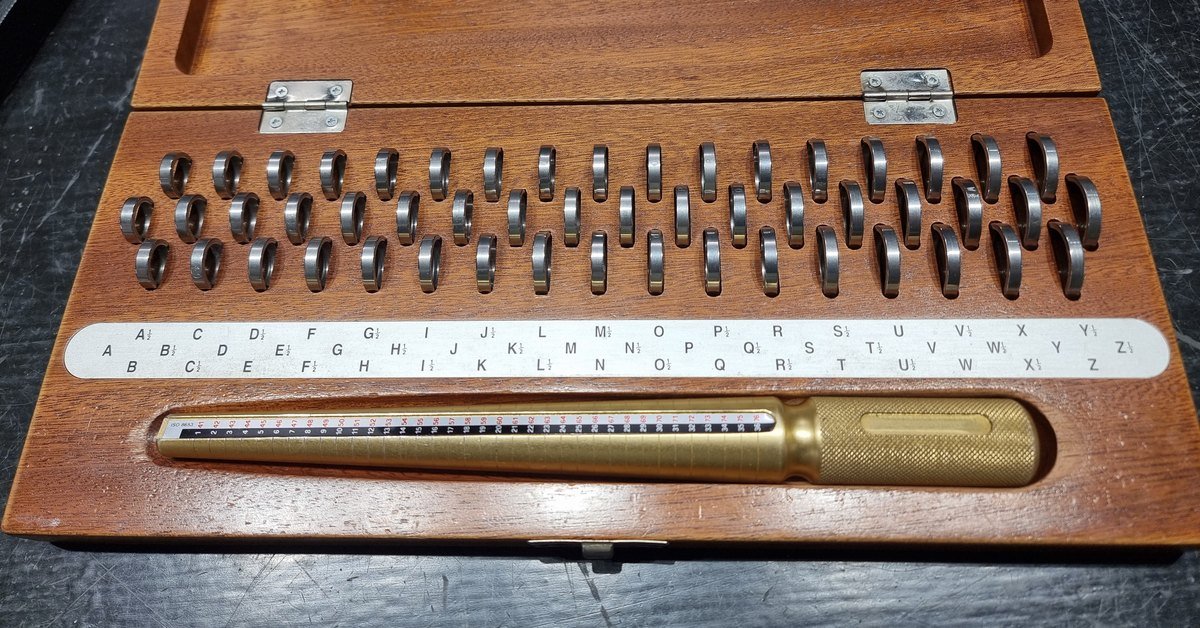
Lead photo: A ring sizing set with gauge rings, an A to Z letter scale and a ring stick. Photo: Richard Avery, CC BY-SA 4.0, via Wikimedia Commons (cropped).