

If you’re holding a pitching wedge and wondering, “What degree is this club, really?”—you’re not alone. Golfers of all levels, from beginners learning wedge angles to seasoned players fine-tuning distance gaps, ask this exact question. The truth is that the pitching wedge loft angle isn’t fixed it varies by manufacturer, club design, and even by year. And understanding what degree is a pitching wedge matters because it shapes how high the ball launches, how far it flies, and how confidently you attack short-game shots.
Let’s break it down with simple charts, comparisons, and expert-backed insights you won’t find crammed into generic guides.
Quick Answer
A pitching wedge is usually between 44° and 46° of loft, depending on the brand and model. Older, more traditional wedges often had lofts closer to 48°, while modern sets are trending stronger at 44°. If you’re asking what degree is a pitching wedge in today’s game the answer is a flexible range, not one fixed number.
What Degree Loft Is a Pitching Wedge in Golf?
Most pitching wedges fall between 44° and 46° loft today. This range is designed for shots around 100–130 yards, depending on your swing speed.
- Traditional Pitching Wedge Degree: ~48° (common before the 1990s).
- Modern Pitching Wedge Loft: 44°–46° (brands like Callaway and TaylorMade).
- Game-Improvement Irons: Some sets push as low as 43°.
Quick takeaway: If your wedge is newer, it’s probably stronger (lower loft). In other words, what degree is a pitching wedge depends on whether it’s modern or traditional.
The Evolution of Pitching Wedge Loft: From Tradition to Modern Power
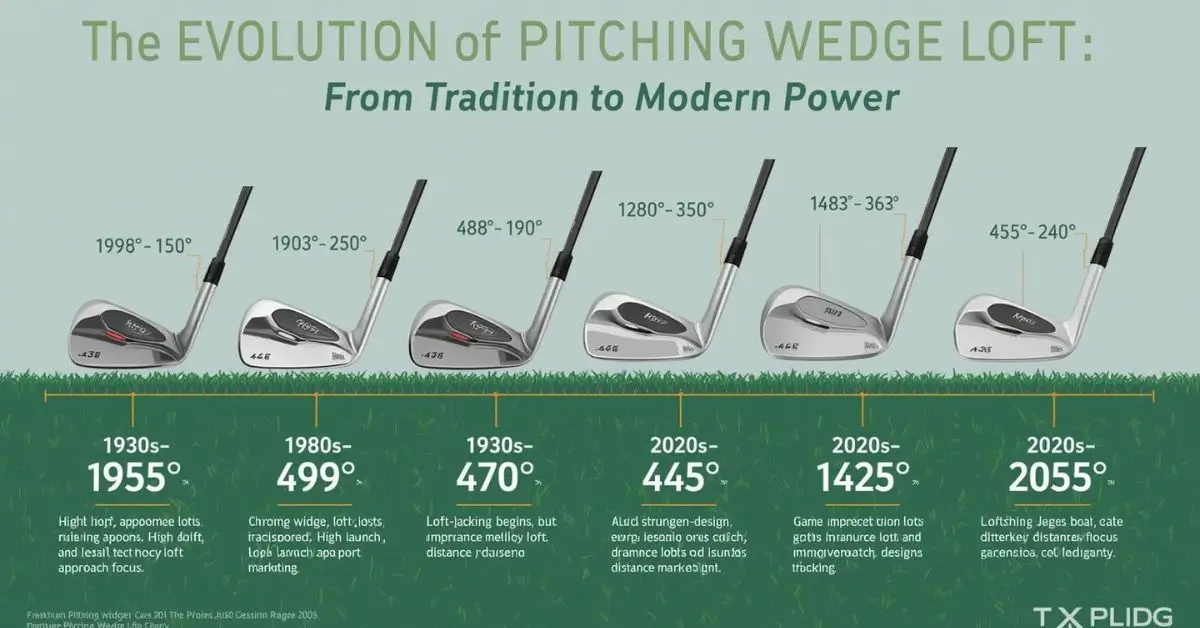
Golf wedges didn’t always launch the ball the same way over the decades, the degree of a pitching wedge has shifted as brands chased distance and precision.
| Era / Decade | Typical Loft (°) | Notes on Design & Trends |
| 1930s–1950s | ~50° | Early pitching wedges were closer to today’s gap wedges. Designed mainly for approach shots with high launch. |
| 1960s–1970s | 48°–49° | Standardized at higher lofts; consistency became the goal. |
| 1980s | 47°–48° | Still traditional; lofts were stable, with little manufacturer variation. |
| 1990s | 46°–47° | Start of “loft jacking” as brands pushed for distance in irons. |
| 2000s | 45°–46° | Stronger lofts became common, especially in game-improvement clubs. |
| 2010s | 44°–45° | Distance-driven design took over; gap wedges became essential. |
| 2020s–Present (2025) | 44° (sometimes as low as 43°) | Modern trend: stronger lofts, marketed for extra distance. Gap and lob wedges now fill gapping needs. |
This table makes it clear: the pitching wedge degree has shifted nearly 6–7° stronger since its invention, redefining short-game strategy for every golfer.
Why Do Modern Pitching Wedges Have Stronger Lofts?
Manufacturers have adjusted lofts to match longer iron distances and consumer expectations. Stronger lofts = longer shots. The trade-off? You often need to add a gap wedge to fill the distance between your pitching wedge and sand wedge.
According to Golf.com, this “loft jacking” trend has reshaped wedge gapping for the past 30 years and changed the answer to what degree is a pitching wedge compared to earlier eras.
Pitching Wedge Loft Chart by Brand (2025 Models)
| Brand | Pitching Wedge Loft | Notes |
| Titleist | 46° | Classic setup, more traditional |
| Callaway | 44°–45° | Stronger loft for distance |
| TaylorMade | 45° | Balanced between distance & spin |
| Ping | 44° | Often paired with gap wedges |
| Mizuno | 46° | Keeps closer to tradition |
(Source: manufacturer spec sheets, CallawayGolf.com)
This chart shows why there’s no one-size-fits-all answer when people ask what degree is a pitching wedge.
Pitching Wedge Yardage Guide
Loft directly affects yardage, but distance also depends on your swing speed.
- Beginner Golfer: 80–100 yards
- Intermediate Golfer: 100–120 yards
- Low-Handicap Player: 120–135 yards
Remember: It’s not about copying a pro’s distance, but knowing your own average. Understanding what degree is a pitching wedge in your bag will also help predict your yardage gaps.
Pitching Wedge vs Other Clubs
Pitching Wedge vs Gap Wedge Loft Difference
- Pitching wedge: 44°–46°
- Gap wedge: 50°–52°
- Difference: ~4–6°, which equals about 10–15 yards in distance.
Pitching Wedge vs Sand Wedge Degrees Explained
- Pitching wedge: 44°–46°
- Sand wedge: 54°–56°
- The sand wedge is designed for bunkers and high, soft shots.
Pitching Wedge vs 9 Iron Loft Comparison
- 9 iron: ~39°–41°
- Pitching wedge: 44°–46°
- Difference: ~4–5°, again about a 10–15 yard gap.
These comparisons highlight why knowing what degree is a pitching wedge matters when building your set.
Wedge Gapping in Golf: Why It Matters
Good golfers don’t leave distance “dead zones.”
- If your pitching wedge is 44°, you’ll likely need a gap wedge at 50°.
- If your pitching wedge is 46°–48°, you may only need a sand wedge at 54°.
Pro Tip: Always test your yardages on the range instead of trusting the stamped number. Answering what degree is a pitching wedge is step one; testing real distance is step two.
Sources:
- Callaway Golf – Official Club Specifications: for up-to-date loft degrees and wedge specs across models.
- Golf.com: industry reporting on wedge loft trends and the “loft jacking” phenomenon in modern irons.
- Titleist (titleist.com): manufacturer data sheets on traditional and modern pitching wedge lofts.
Final Thoughts
So, what degree is a pitching wedge? The short answer is 44°–46° in modern sets, closer to 48° in older ones. That single number matters more than you think—it affects your yardages, your gapping, and ultimately your confidence with scoring shots.
If you’re building your bag or upgrading clubs, start by checking the pitching wedge specs. It’ll guide whether you need a gap wedge, sand wedge, or even a lob wedge to complete your set.
Read More:
FAQ’s
How many yards does a pitching wedge hit?
For most players, a pitching wedge carries between 100 and 120 yards. Beginners may hit shorter, pros often longer.
Is a 44 degree wedge the same as a pitching wedge?
Yes, many modern pitching wedges are 44°. But always check the manufacturer’s specs when asking what degree is a pitching wedge.
What degree should a beginner’s pitching wedge be?
A 46° wedge is beginner-friendly because it offers a higher launch and more control than a strong 44°.
Do all pitching wedges have the same loft?
No. Lofts vary by brand, model, and year. Always confirm your club’s specs—there isn’t one permanent answer to what degree is a pitching wedge.
Which wedge to use for 100 yard shots?
Most golfers use a pitching wedge for a full swing from 100 yards. But if your wedge is stronger (44°), you may need a gap wedge for more control.
Is a pitching wedge good for chipping?
Yes. Many golfers use pitching wedges for bump-and-run chips because the loft provides just enough lift without too much spin.
Best pitching wedge loft for accuracy?
Lofts around 46° strike a balance—high enough for control, low enough for distance consistency.
Why do modern pitching wedges have stronger lofts?
Clubmakers design stronger lofts so golfers can hit longer distances. It also helps sell the idea of “longer irons,” but it requires adding more wedges.
Author Bio
Written by Daniel Crestfield, golf and sports content writer with a background in SEO-driven equipment guides. With a degree in communications and years of experience simplifying technical topics, Daniel specializes in making golf knowledge clear and accessible for everyday players.